I've just watched Susan Blackmore giving a talk at TED, prompted by a New Scientist article. In it she effectively proposes that what makes us human is that we are mimics. In fact our ability to mimic others is so extraordinary that we have become the progenitors of another form of life.
But I have one niggling doubt about her hypothesis and the idea of evolution in general, and that is: how is it possible to distinguish a replicator that is blind and lucky and one that actively ensures its own survival?
Take the meme for a two pence coin for example. Clearly, it has been quite successful. There are probably millions of them in circulation and they fulfil their 'function' very well. Of course the physical coin is only an embodiment of the meme (the same way we are embodiments of genes); but we can use the coin as a proxy for the meme.
So how can we tell if the two pence coin actively ensures its own survival, to be passed down its generations, or has just been lucky enough to survive this long? In other words can we tell if the meme for a two pence coin has a directed purpose?
Firstly, we have to distinguish being lucky from having a purpose (to make sure it replicates). For example a piece of 3.5 billion year old rock just dug up from the ground, has probably just been lucky to have stuck around for so long. What about the chemical reaction that started life all those billions of years ago? Now we're not so sure, luck has undoubtedly played a part, but there must be something else that keeps the life replicators alive through the ages. In a word: feedback.
More specifically feedback with the replicator's environment. The replicator tips the survival odds in its favour by affecting the very thing that produces those odds, its environment. Now it becomes simpler to see how this could evolve, as any replicator necessarily uses resources from its environment in order to reproduce itself. This forms a feedback loop which the replicator can use to its advantage. Note that the replicator doesn't initially actively set out to change its odds of replicating, it just gets lucky with one of its feedback loops.
And this is my main niggle with the way evolution is portrayed, in that an organism (replicator) becomes as fit as possible in its niche over its evolution. It's not the whole story, the whole story is that the replicator changes it's niche because it's stuck in a feedback loop with it. So in a sense the niche becomes fit to the replicator.
So where does this leave our humble two pence coin? For sure, the meme has affected millions of humans (its environment) and we all buy into the delusion of what it can do for us and what it stands for.
May it live long and prosper.
Friday, 14 August 2009

Thursday, 5 March 2009
Computers
I often wonder what I would be doing if I didn't program computers for a living. I have had several influences in my life that have directed me this way.
My first was my dad's Hewlett Packard calculator. I must have been four years old when I got my hands on it. Of course I had no idea what it was really for. But I could read numbers. I quickly learned that I could add numbers and I understood that. But some of the keys mysteriously produced what seemed to be random digits and that really piqued my curiosity. By playing around I worked out that the same keys would always produce consistent results, so somehow they did something meaningful, I just couldn't imagine what. So I asked the oracle: my father.
He did some drawings and explanations of trig, and I think I half understood it, not bad for a four year old and I also half understood how the numbers on the calculator related to it. Of course to grasp that I had to understand what fractions were about: no problem apparently.
So the stage was set, the combination of buttons, numbers and patterns was intoxicating.
The next big moment was due to my uncle. He'd recently bought a ZX81 one of the very first home computers. And on a visit to his, he let me play on it. I was probably nine years old. He showed me a program showing a four stroke engine and a flight simulator. I found the visual aspect of it was enthralling, it was like nothing else I'd seen. And the computer's size and mysterious symbols on the keyboard appealed to me. But it was when my uncle showed me a program that he'd written to simulate two steam engines crashing together, that I was hooked. Steam engines were of course my other passion! Seeing that program gave me the same thrill as playing with the calculator: the symbols may be weird, but they could be deciphered and understood and I could even create my own mini-world with it.
The thought of that black ZX81 swam around in my head, until I could nearly contain it no longer, I just had to have one. I would wait a year until the next Birthday/Christmas came along. I was writing my first program in hours, and that was it, I became a programmer.
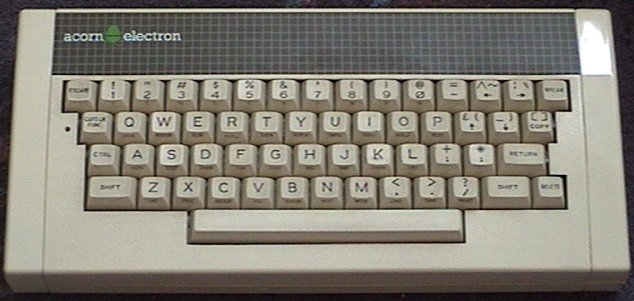
Of course time passed and bigger and better things always come along. I saw 'The Computer Program' not long after and saw the BBC Microcomputer in action for the first time. It did everything my computer did but better. It had colour, sound and I could even create dancing men on the screen if I wanted. It was amazing. I yearned for one, but I had no excuse, I already had a computer. And a beeb was very expensive too. So I waited and waited. Until my parents caved and bought me an Acorn Electron. Not a beeb but good enough to spend hours, days and weeks, writing programs for it. I learned assembly language and how computers ticked and soon realised there was a huge unfathomable pit of learning that I could do...
My first was my dad's Hewlett Packard calculator. I must have been four years old when I got my hands on it. Of course I had no idea what it was really for. But I could read numbers. I quickly learned that I could add numbers and I understood that. But some of the keys mysteriously produced what seemed to be random digits and that really piqued my curiosity. By playing around I worked out that the same keys would always produce consistent results, so somehow they did something meaningful, I just couldn't imagine what. So I asked the oracle: my father.
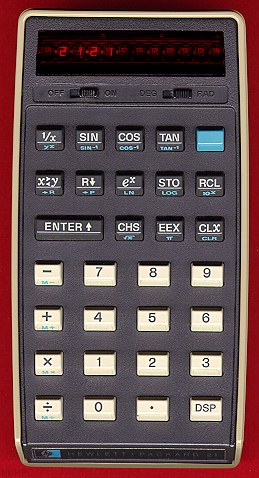
He did some drawings and explanations of trig, and I think I half understood it, not bad for a four year old and I also half understood how the numbers on the calculator related to it. Of course to grasp that I had to understand what fractions were about: no problem apparently.
So the stage was set, the combination of buttons, numbers and patterns was intoxicating.
The next big moment was due to my uncle. He'd recently bought a ZX81 one of the very first home computers. And on a visit to his, he let me play on it. I was probably nine years old. He showed me a program showing a four stroke engine and a flight simulator. I found the visual aspect of it was enthralling, it was like nothing else I'd seen. And the computer's size and mysterious symbols on the keyboard appealed to me. But it was when my uncle showed me a program that he'd written to simulate two steam engines crashing together, that I was hooked. Steam engines were of course my other passion! Seeing that program gave me the same thrill as playing with the calculator: the symbols may be weird, but they could be deciphered and understood and I could even create my own mini-world with it.

The thought of that black ZX81 swam around in my head, until I could nearly contain it no longer, I just had to have one. I would wait a year until the next Birthday/Christmas came along. I was writing my first program in hours, and that was it, I became a programmer.
Of course time passed and bigger and better things always come along. I saw 'The Computer Program' not long after and saw the BBC Microcomputer in action for the first time. It did everything my computer did but better. It had colour, sound and I could even create dancing men on the screen if I wanted. It was amazing. I yearned for one, but I had no excuse, I already had a computer. And a beeb was very expensive too. So I waited and waited. Until my parents caved and bought me an Acorn Electron. Not a beeb but good enough to spend hours, days and weeks, writing programs for it. I learned assembly language and how computers ticked and soon realised there was a huge unfathomable pit of learning that I could do...
Subscribe to:
Posts (Atom)